(LOADING)
© LSG

Lunar has acquired Sharma Brands: Learn More

Are Bot Clicks Impacting Your Klaviyo Account?

Published October 25, 2024

Bot Clicks: How To Reduce Their Impact on Your Lifecycle Marketing

Bot Clicks Impacting Your Klaviyo Account

In the last few months you may have heard rumblings of click rates decreasing. We’ve seen it across accounts: click rates suddenly dropping with no explanation. This can be alarming for marketers, especially with click rate being a key indicator of email performance and account health.

In reality, we have learned that bot clicks increased at the beginning of the year and have dropped off over recent months, making click rates appear to have declined suddenly.

What Are Bot Clicks?

According to Klaviyo, “a bot click refers to an email or SMS click performed by a machine, often to verify the safety of a link or display a link preview”. When an email is sent from Klaviyo to an inbox provider, the inbox provider or some 3rd-party security softwares may go into the email and “click” the email links to ensure that they aren’t malicious URLs.

Within Klaviyo, these clicks will appear as if the person receiving the email has clicked, skewing performance metrics. Until recently there was no way to decipher real from bot clicks.

What’s Changed?

While bot clicks have always existed, they have been too minimal to impact performance. However, earlier this year these clicks increased significantly for most email providers, resulting in dramatically increased, artificially inflated click rates.

With that trend reversing over the past few months, some marketers have worried their performance is declining without realizing the impact of bot clicks. Fortunately, though, these clicks can now be removed from all reporting data via a new beta feature within Klaviyo. Now, we can determine exactly how much bot clicks have impacted performance metrics, and what the “true” click rate has been for accounts.

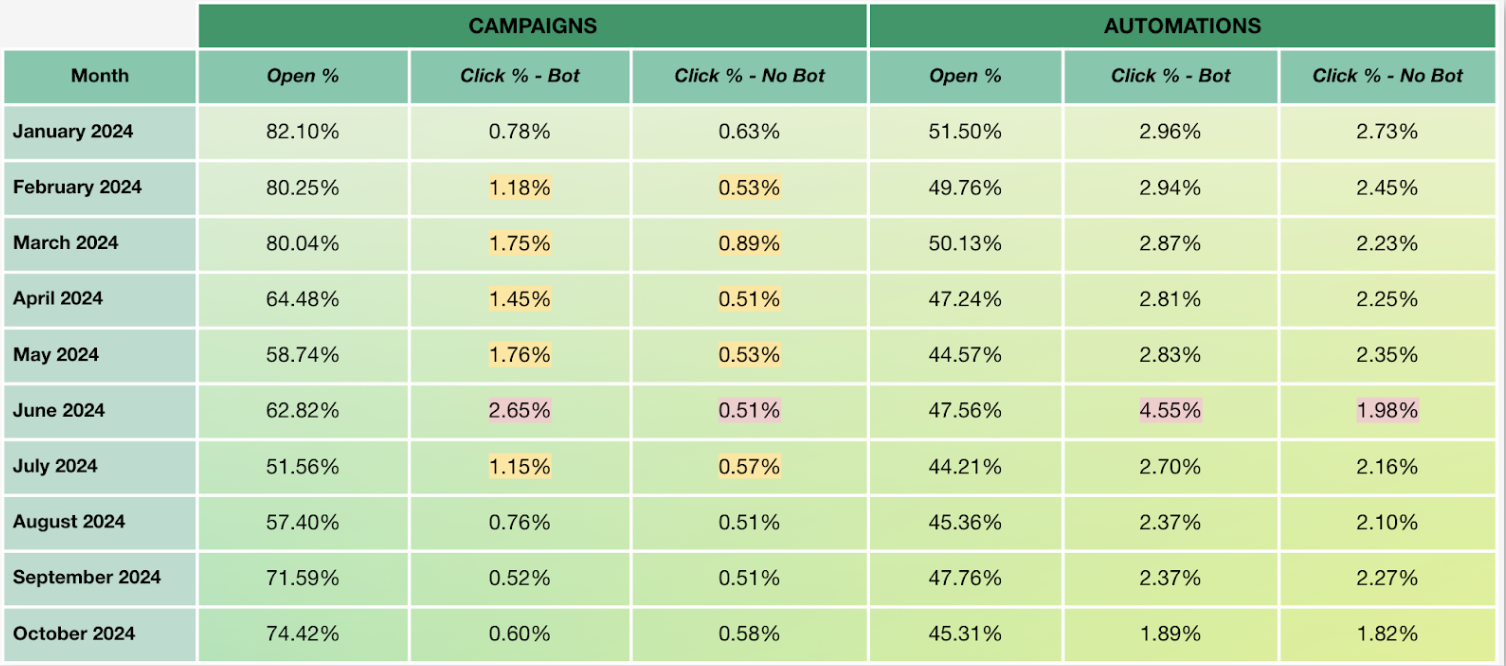
In the example below, one account that we analyzed saw the campaign click rate was 118% higher on average when including bot clicks compared to the true click rate excluding that bot engagement. In June, we can see bot activity peaked with a 420% higher campaign click rate and a 130% higher flow click rate compared to reports excluding bot clicks. Despite what the unfiltered data suggested, engagement rates were actually lower in June compared to the YTD averages. Without enabling this feature to exclude bot engagement from reporting, this brand might otherwise have wondered why campaigns yielded peak engagement rates with lower than average revenue that month.
Chart

Exclude bot clicks from Email and SMS Reporting with Klaviyo’s new beta feature. Here’s how to view your brand’s true click rates:

Enable Klaviyo’s New Beta Feature

Removing bot clicks from your reporting is super simple, you’ll just need to make an adjustment to Klaviyo settings:

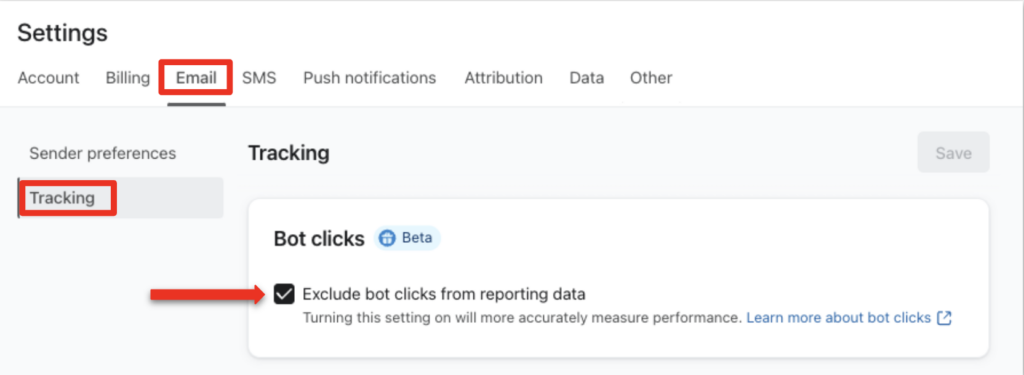
  • In Klaviyo, navigate to “Settings” by clicking the account name in the bottom left corner.
  • Once in “Settings”, click → “Email” → “Tracking”.
  • Check the box to “Exclude bot clicks from reporting data” and refresh Klaviyo.
Need help?

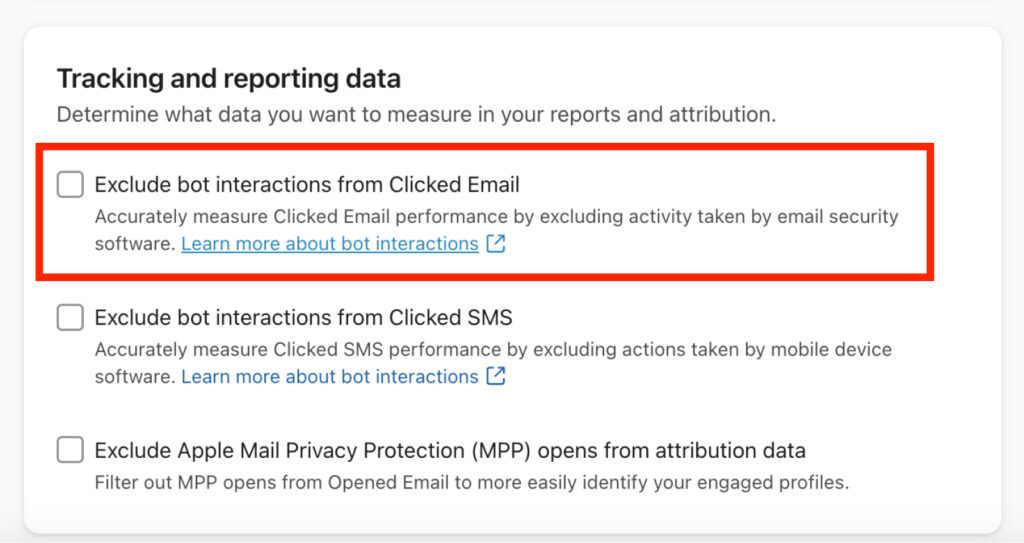
It’s important to note that this feature will only remove bot clicks from click reporting, but not from attribution. If you’d like to remove bot clicks from attribution as well, you’ll need to toggle on an additional feature within your attribution settings in Klaviyo (see image below). Note that toggling this on or off will not make any retroactive changes to past reporting— changing this setting will only impact future reporting.

Attachment

Need help assessing how bot clicks have impacted your Email & SMS Marketing? We’re here to help.

Get in touch.

Lunar Acquires MuteSix

Published October 22, 2024

Lunar Acquires MuteSix: An Update from Lunar’s Founder

I’m thrilled to announce Lunar’s successful acquisition of MuteSix from Dentsu, effective October 1, 2024.

This marks a significant milestone in both Lunar’s and MuteSix’s journeys and promises to unlock new synergies, expanded capabilities, and accelerated strategy and technology innovation.

When I first started Lunar in late 2017, MuteSix was the gold standard in direct response performance media buying. Their team’s talent, case studies, client roster, etc., served as a benchmark that I hoped Lunar could someday achieve. It’s exciting to now have the opportunity to usher MuteSix into its next chapter.

If you’re new to Lunar, we’re a growth consultancy, technology studio, and full-service digital marketing agency. Over the last six years, I’m really proud of our team for…

  • Foreseeing iOS 14 attribution issues, building KnoCommerce, and pioneering the use of “always on” consumer insight surveying for media buying and “how did you hear about us” surveys for attribution.
  • Watching CPG in-store demos disappear during COVID-19 and incubating Aisle to drive in-store trial and velocity through the register with 1:1 attribution.
  • Seeing CACs rise and a need for better LTV, we built Stay AI and completely reinvented the subscription space via dozens of new-to-market features.
  • Building best-in-class ecommerce and digital marketing programs for hundreds of high-growth brands over the years like Olipop, Chomps, Vita Coco, enewton, and RYZE.

At Lunar, we give our partners an edge over the competition by not just leveraging the best technology and newest strategies but by pushing the industry forward. Our tools and strategies are leveraged by 5,000+ brands and hundreds of agency and technology partners.

A couple of months ago we raised a Series A from our venture partners, which is probably perceived as an unusual move for an agency. The next chapter for Lunar is focused on marrying our expertise in technology innovation and services via nearly a dozen new technology solutions being built exclusively for our partners.

I’m thrilled to combine MuteSix’s media and creative expertise with Lunar’s proprietary technologies, CRO, and web services to enhance both groups’ full-funnel capabilities. MuteSix’s team brings significant production capabilities, TikTok expertise, and depth of programmatic expertise that will undoubtedly benefit Lunar’s current partners.

The combined expertise of both teams will enable the delivery of more integrated and effective solutions, addressing complex business challenges with a holistic approach. Clients can look forward to enhanced strategic insights, innovative solutions, and a seamless experience across the full spectrum of services. Lunar Solar Group and MuteSix are united in their goal of driving transformative results and supporting their clients in navigating the ever-evolving digital landscape.

If you’re a MuteSix client, team member, or partner, we’re excited to welcome you to the Lunar ecosystem and look forward to helping you achieve your goals and Grow Beyond.


 – Pierson Krass, Founder & CEO of Lunar Solar Group

About MuteSix:

Founded in 2013 by Steve Weiss and Daniel Rutberg, MuteSix is one of the pioneers of performance marketing for direct-to-consumer ecommerce. MuteSix has an unparalleled track record in direct response advertising having driven billions of dollars in trackable ecommerce revenue for brands like Therabody, Theory, Farmacy Beauty, and Ring. With hundreds of alumni now shaping the ecommerce and performance marketing landscape, MuteSix’s has had and will continue to have an undisputable impact on the ecosystem.

About Lunar:

Lunar is a globally recognized growth consultancy, technology studio, and full-service digital marketing agency, dedicated to driving transformational growth for bold, disruptive brands. Lunar’s team breaks through growth barriers by combining proprietary technology, innovative strategies, and seamless channel execution. From helping startups find product-market fit to reigniting legacy brands growth through digital transformation, Lunar partners with businesses at every stage of growth.

Google Introduces New PMax Rules

Published October 21, 2024

Google Defines New Rules for Shopping Auction Dynamics

Google Defines New Rules for Shopping Auction Dynamics

Q4 is off to an exciting start with Google introducing a fundamental shift in how Performance Max and Standard Shopping campaigns battle for attention within the ad auction. This promises to bring greater balance and transparency to the auction process, while demanding a more nuanced approach to campaign management. (image source: Google)

Performance Max No Longer Prioritized Over Standard Shopping

Historically, PMax campaigns have enjoyed preferential treatment, often outranking Standard Shopping campaigns in the ad auction hierarchy. This created an uneven playing field for advertisers relying on Standard Shopping campaigns.

As of October 2024, Google will gradually release an update to level the auction priority playing field between Standard Shopping and Performance Max campaigns targeting the same product.

Ad Rank and Product Prioritization is the New Deciding Factor

The ad with the highest Ad Rank will be the one displayed, regardless of whether it originates from a PMax or Standard Shopping campaign.

Google calculates the Ad Rank for each eligible product in real time to determine the position in the search results. Ad Rank is influenced by several factors:

  • Bid: The maximum amount you’re willing to pay for a click on your ad.
  • Data quality: How complete and accurate your product data is (titles, descriptions, GTINs, images, etc.)
  • Product relevance: How closely your product data matches the user’s search query.
  • Predicted click-through rate (CTR): Google’s estimate of how likely someone is to click on your ad based on historical performance and feed optimization.
  • Cost: When a user clicks on your ad, you pay a cost-per-click (CPC). The actual CPC is often less than your maximum bid and is influenced by the Ad Rank of the product below yours in the auction.

New Auction Rules, New Shopping Strategy. Google advertisers must be proactive and adaptable. Here’s a roadmap to guide your efforts:

New Auction Rules

(image source: Google)

Optimize Budgets and Targeting

Revisit your budgets and targeting settings across all campaigns to ensure they’re aligned with the new auction dynamics. A granular approach to budget allocation and audience targeting will be essential.

Refine Performance Max Capabilities

  • Final URL Expansion & Page Feeds:
    • Expand your URL coverage to capture a wider range of relevant search queries.
    • For product feed campaigns, ensure you are targeting relevant SKUs in your product listing.
    • For non product feed campaigns, use a page feed strategy, or page targets and exclusions to better refine dynamic landing pages.
  • Strategic Asset Grouping & Compelling Creative:
    • Organize your assets into cohesive and relevant groups to enhance ad relevance and quality.
    • As Standard Shopping becomes more viable, the creative aspects of Performance Max may start serving more than they have previously.
    • Utilize high-quality creatives and engaging videos to capture user attention and drive conversions.

Potential Strategies With Shopping and PMax

These new strategies let you combine the automation of Performance Max with the control of Standard Shopping. Consider new structures like:

  • Non-Brand Performance Max for lower performing SKUs with Standard Shopping focusing on top converting products for budget allocation considerations.
  • Brand Performance Max and non-brand Standard Shopping. This was not easily done before; however, these new rules pave the way to structure your account this way.
  • New Customer Acquisition Performance Max with Standard Shopping with brand, remarketing, and retention layers. This captures users already in the funnel for a more efficient ROAS when they search product keywords, leveraging PMax of discovery.

There are certainly more advanced, and far more specific structures you can test with these new rules.

Google’s Continued AI-Driven Evolution

Being able to leverage both Standard Shopping and Performance Max more easily means more advertisers will be willing to run both side-by-side, and not have to take such an aggressive approach to choosing a shopping inventory solution.

Adapt your strategies, and leverage the new auction dynamics to your advantage. With careful planning, meticulous optimization, and a willingness to run both, you can navigate this new era of Google Ads and scale shopping inventory like Smart Shopping was still around.

Looking for help with your Google, Meta, or any other element of your marketing mix? If you’ve got problems, we’re here to help.

Get in touch.

Last-Minute BFCM Checklist

Published October 17, 2024

Setting Yourself up for Success: Our Last Minute BFCM Checklist

BFCM Checklist

Happy Q4! We’re here to share some digital tips & tricks to help you put the finishing touches on your plans for a smooth sailing, brand scaling Black Friday-Cyber Monday weekend.

Shoppers are estimated to spend $10 billion on Black Friday in 2024, up from $9.8 billion in 2023, with 42% of consumers planning to shop online. Still though, inflation and interest rates have put many people on a budget in 2024. It is reasonable to expect, especially with crowded markets and platforms, that consumers will be more selective about which brands they shop from.

That makes your BFCM prep even more crucial as consumers want to consider and plan their purchases. Almost 60% of shoppers start their holiday shopping in October or November, and 44% plan their BFCM purchases more than a week in advance.

Here’s what we think you should do about it.

1. Start Early

Ideally, you already have this part of the plan in motion or complete.

Map out your campaign strategy, goals, and budgets so that you can start capturing your buyers’ attention with increased spend on top-of-funnel campaigns throughout October. Lock your promotion in as well so that you’re able to source and design the necessary content in advance.

Depending on the contrast between your BAU and BFCM budgets, it may help to start scaling in increments before the sale starts. For example, one jewelry brand partnering with Lunar Solar Group scales their daily Meta spend by a whopping 7,400% on Black Friday compared to their typical budget. If they tried increasing spend by that amount overnight, not only would the account likely be unable to hit our desired budgets, but the delivery and ROAS would be pretty poor.

Also with Meta ads, wherever it makes sense to do so, have your ads built out in campaigns that are ready to turn on several days before you plan to launch your sale. With the spike in advertising around BFCM, platform review periods can lengthen. You want ads ready to be delivered when your sale launches, not stuck in a review period. In cases where you’re leveraging existing campaigns, consider implementing additional QA checkpoints within your team to avoid setting sale material live sooner than intended.

As far as when to launch the deals themselves, starting early can be very helpful here too as we know the bulk of 2024 sales are set to begin in early November; Walmart’s 2023 sale began on November 8th and Amazon started offering Black Friday deals on November 17, 2023. If margins allow, launching a lower tier “early sale” within the first two weeks of November can help put you on customers’ radars ahead of (or at least alongside) your competitors. However, that’s not feasible, or necessary, for every brand. From a platform perspective, it does certainly help to allow ads to run for several days building social proof before they reach peak efficiency, so being able to launch your offer prior to Black Friday can be an advantage for paid ads.

Start Early

2. Grow Your Audience Before The Sale Begins

Drive as much traffic and as many email/SMS signups as possible in the months and weeks leading up to BFCM. That way, you’ll have a larger pool of potential customers to retarget when sales kick off. Remember that almost half of shoppers are planning their purchases now, so this is the time to get consumers familiar with your brand, putting them in the consideration phase.

Some examples of this prep work include:

  • Optimizing your website pop-ups to increase sign up rates.
  • Investing in list building tactics such as lead generation and tools like HiTide that turn social engagement into SMS subscriptions.
  • Leveraging influencers to create unique content and generate awareness with their audiences ahead of time.
  • Making organic content extra engaging with seasonally relevant material, polls that invoke user responses, interactive contests, etc.
  • Tapping into affiliate marketing that can put you on ‘Best Holiday Gifts of 2024’ lists.

Last-Minute BFCM Checklist

3. Optimize Your Site

This should go without saying at this point, but optimize for mobile, and fix any issues creating a slow site speed before the big weekend. To really fine-tune your conversion rates and create a customer experience that encourages brand loyalty, you should also be sure to:

  • Set your Buy Boxes to default to a subscription option
  • A/B test headlines and CTAs
  • Keep your value props clear and prioritized according to customer pain points
  • Test your discount functionality in advance
  • Bonus points if you can leverage dynamic customization on your site

Keep in mind that during the holiday season especially, consumers care about shipping times and costs, so be sure to emphasize that as well throughout the shopping experience.

4. Creative

Consumers are going to be getting A LOT of ads and emails over BFCM. Come prepared with data-backed decisions.

  • Make eye-catching creatives that stick out with the brand identity, the product, and the offer. If you’re having a hard time taking a step back and viewing material with a consumer mindset, consider using tools like Neurons that will scan creative and tell you where attention is being drawn to.
  • Create urgency. Language like, “Sold Out 10 Times”, “Limited Edition”, and “First 200 Customers Only”, can drive demand. Countdown clock visuals are also great for this.
  • Messaging should feature a balanced mix of brand values and enticing offers. Match the audience’s needs with your USPs.
  • Clarity wins. It’s good to be prepared with a variety of asset types, but come prepared with some uncomplicated graphics that clearly show the offer.
  • Learn from past campaign performance to understand what worked and what didn’t. Shockingly, we tend to find that leaning into seasonality with gifting visuals goes a long way.
  • Refresh evergreen ad creative in November. It’s easy to get caught up in the sale prep and neglect evergreen efforts, but these ads are likely to drive a healthy chunk of your platform revenue over BFCM if you let them.

5. Take Care Of Existing Customers

Don’t get so excited about acquiring a record number of new customers that you forget to take care of your existing ones.

Exclude previous purchasers and subscribers from messaging with deals intended for first-time customers. Even better, offer subscribers and previous purchasers a better deal if you can.

If steep discounts aren’t doable for your brand, you can still show those previous purchasers some love with:

  • Early access or exclusive extended deals
  • Referral & loyalty programs
  • Upsell and cross-sell with add-ons
  • Limited edition items
  • Gift wrapping
  • Customizable options

Depending on your customer demographic, go the extra mile and consider a mobile app. Communicate more directly with your most loyal customers via push notifications, and provide an exclusive shopping experience where the conversion rate is 40% higher on average compared to mobile web. Tapcart is our recommended solution for creating an app without the custom development resources. Our friends there report that 89% of Gen Z and 84% of Millennials would like to have mobile app shopping options, so it’s an in-demand capability for many consumers.

6. Set Yourself Up To Retain New Customers

Leading brands know that retention begins at the moment of acquisition. Too many others don’t put a plan in place for nurturing their massive cohort of BFCM-acquired customers. This makes for poor cLTV and profitability struggles in Q1 after a ton of inventory moves at a discounted price in Q4.

  • Focus on quick shipping, easy returns, and effective communication to enhance the customer journey.
  • Audit your SMS and email flows to be sure the journey for these first-time customers is a positive one.
  • Implement quizzes and surveys in advance to learn about customer segments for customized re-engagement.
  • Get your win-back and subscription program in good shape (our friends at Stay AI have their own playbook for the must-dos here).

7. Get Ready To Close Those Deals

While the BFCM preparation is important, the job doesn’t end there!

For ad accounts making big jumps in spend on Black Friday— set your budgets and turn on campaigns as the sale itself launches (usually midnight EST). You may be thinking that folks aren’t online shopping in those early hour mornings, but big budget changes take time to settle in. You might not reach your budget if the account isn’t pacing to spread the target spend across the entire day, so either schedule those changes, or stay awake to do it manually!

Send multiple emails! Consumers will be getting sale notifications from every brand they have ever shopped at. If you send just an opening BFCM sale email and an “Incase You Missed It” message at the end of the weekend, consumers may shop a competing sale before they get your reminder. Differentiate your messaging, of course, but don’t be afraid to send a daily email and/or SMS notification. See some extra tips from Klaviyo on how to plan sends for each day.

In December, run last minute gifting, shipping cut-off, gift card, and “better late than never” messaging to convert anyone left in your funnel. Chances are, this is also when you’re doing your own holiday shopping!

Have more questions? Get in touch with our team!


Get Ready To Close Those Deals